
On December 28, the national finals of the 8th China Digital Vehicle Competition were held in Wuqing District, Tianjin. The project designed by doctoral student Cai Shijie and instructed by Professor Hu Jie, both from the School of Automotive Engineering at WUT, won the National Grand Prize in the Innovation Group. The project, titled “A Multi-dimensional Coupling Energy Consumption Prediction Algorithm for the Human-Vehicle-Environment System”, emerged as the top winner after rigorous selection rounds, including preliminary reviews, regional finals, 1v1 defense, national finals, and the final grand prize defense. It ranked first in both algorithm accuracy and performance in project proposal defense.
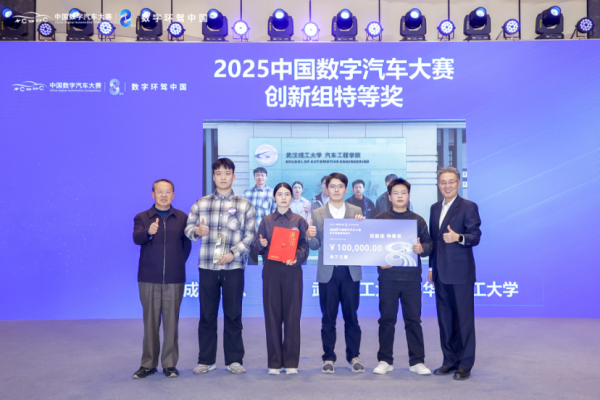
The China Digital Vehicle Competition, which is part of the Formula Student China series, was founded in 2018 and has been held successfully for eight sessions to date. The competition is co-hosted by the National Big Data Alliance of New Energy Vehicles and the China Society of Automotive Engineers. Building upon massive real-time operation data of new energy vehicles, and emphasizing data algorithm innovation, and data analysis and application, this event aims to unlock data value and develop innovative applications, in order to discover and cultivate talents in new energy vehicles, and provide a platform for students with innovative and entrepreneurial ideas. 8162 participants out of 758 universities from home and abroad registered for the competition and submitted over 1000 projects for the preliminary rounds. After multiple rounds of review, 28 teams were selected for the offline finals.
To address uncertainties in driving style and traffic environment in public scenarios, and challenges in the accurate prediction of energy consumption caused by long-tailed distributions of data samples, the team developed a multi-dimensional coupling solution for predicting the energy consumption of new energy vehicles, integrating human, vehicle, and environmental factors. The team developed a multi-scale data augmentation strategy to effectively alleviate uneven sample distribution, proposed a hybrid battery capacity calibration strategy that combines rule-based and learning-based methods to enhance calibration accuracy of core parameters, and created a driving style recognition method for real-world scenarios to accurately characterize driving behaviors. Ultimately, the team has developed an adaptive framework for predicting energy consumption based on GAPFormer, which, combined with a cost-sensitive strategy, significantly improved the accuracy of energy consumption prediction in complex scenarios.
Written by: Cai Shijie
Rewritten by: Mei Mengqi
Edited by: Li Huihui, Li Tiantian
Source: School of Automotive Engineering
|
|