
Recently, a research team led by Professor Sun Huajun from the Silicate Materials Engineering Research Center, Wuhan University of Technology (WUT), has made new progress in the field of ferroelectric materials. The research findings, entitled “Tailoring polarization homogeneity in discontinuous-columnar Bi(Fe,Mn)O3 thin films via dislocation engineering with controlled self-assembly”, were published in the international academic journal Nature Communications. The State Key Laboratory of Silicate Materials for Architectures at WUT serves as the corresponding affiliation. The corresponding authors include Professor Sun Huajun (WUT), Professor Ma Xiaoguang (Ludong University), and Professor Zhang Shujun (City University of Hong Kong).
The research team developed a new controlled self-assembly strategy of dislocation engineering. This strategy could help break the limitations of merely reducing defect density in controlling the ferroelectric polarization of Bi(Fe,Mn)O3(BFMO) thin films. Unlike the existing studies that used monocrystal substrates such as SrTiO3(STO) to minimize dislocation density, this study innovatively employs a face-centered cubic (FCC) Ni-Cr substrate and actively leverages the lattice and thermal expansion mismatch between this substrate and the rhombohedral (R3c) BFMO thin films in rhombohedral phase, thus building a high-density dislocation environment in thin films, and providing an ideal system for controlling dislocation configuration and investigating the dislocation-ferroelectric polarization interaction mechanism. Furthermore, by employing a common LaNiO3 buffer layer, the research team reduced the lattice mismatch between BFMO and Ni-Cr from ~3.8% to ~1.0%, and templated a discontinuous-columnar grain structure. This structure could guide the self-assembly of edge dislocations along grain boundaries in a topologically-protected configuration and form a highly ordered microstructure. This microstructure would promote a more uniform strain field and more coherent FeO6 octahedral tilting, significantly enhance polarization homogeneity, leading to a lower domain-switching barrier and a more uniform domain pinning effect, and strengthen aging stability of thin films. These research findings provide an important theoretical foundation for the defect engineering paradigm of regulating ferroelectric properties through the design of dislocation spatial configuration.
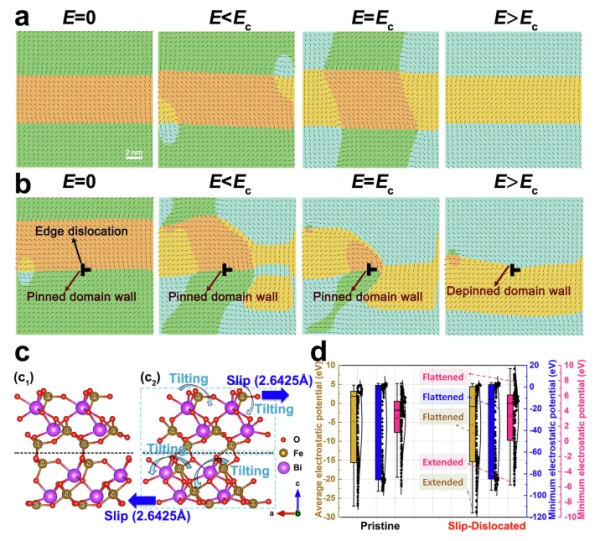
Figure 1 Intrinsic effects of an edge dislocation on ferroelectric polarization in 2D slice of BFMO single crystal viewed along [100] direction.
Paper link: https://www.nature.com/articles/s41467-026-68406-3
Written by: Meng Li, Lu Jianfeng
Rewritten by: Mei Mengqi
Edited by: Li Huihui, Li Tiantian
Source: Silicate Materials Engineering Research Center
|
|